
Armenia: The oldest wine story still being told
VineRoutes
7/6/20268 min read
Originally published by VineRoutes at https://vineroutes.com/armenia-the-oldest-wine-story-still-being-told/
An exploration of Armenia’s ancient wine history, focusing on indigenous varieties, evolving producers, and the landscapes behind them
I’m a pretty good traveler. Armenia is the 70th country I’ve visited, although I have to admit not knowing its capital city, Yerevan. This past May, Armenia hosted the prestigious CMB (Concours Mondial de Bruxelles) Red and White Wines Session, in Yerevan. I received a press trip invite to participate. It’s significant for Armenia as it officially re-opens its doors to the global wine community and enjoys its phoenix moment in the sun.
According to Vahe Keushguerian of Keush Winery, he believes the international competition brought all the right people to Armenia. “These judges, writers, sommeliers, and importers became acquainted with the country’s wines and will, in turn, spread the word globally.”
Read Also: The Peloponnese wine story: Native grapes, ancient sites, and modern producers
From my perspective, the competition was very successful in doing so. Adam Kablanian of Alexandrea Winery concurs. “The event helped put Armenia on the global wine map, accelerating recognition of its viticultural potential. Beyond wine, hosting the CMB is expected to boost tourism by attracting visitors interested in the country’s history, culture, gastronomy, landscapes, and hospitality. Such events strengthen our global image and support long-term growth in tourism, investment, and economic development.”
My goal for this article it to provide some poignant history, and encourage you to visit and experience Armenia for yourself. It’s inspiring to experience a region in early-stage in its modern wine journey. The people I met were effusive about the future of Armenia in general and the wine business specifically.
Included within this guide:
Armenia: the sacred land of wine
What makes Armenia wine special?
Native grapes to know
Wineries to visit
Armenia: the sacred land of wine
Many people believe that wine began in Western Europe, but evidence shows otherwise. Armenia wine is resurfacing after its tumultuous past, a past that dates back 7,000-some-odd years, with documented history of intentional winemaking (not simply spontaneous fermentation) dating back 6,000 years. You’ve heard of the “cradle of wine?” Armenia is one of the Caucasus region countries in the cradle.
In 2010, Armenian and American archaeologists uncovered what’s considered the world’s oldest known winery at the Areni-1 cave in Vayots Dzor, dating back to around 4100 BC., with remains of a winepress, fermentation vats, and clay vessels. Is this the “Birthplace of Wine”? If not, its most certainly proximate.
The sacred volcanic Mount Ararat, formerly located in Armenia (20 miles south of the Turkish border), remains the national symbol of Armenia and is linked to wine. Legend has it that Noah’s Ark came to rest on Mount Ararat, and what’s the first thing Noah did after releasing the animal passengers? His first order of business was to plant vineyards and make wine. Whether you believe the legend or not, it’s a sign that the earliest wine storytelling came out of this area.
So, why haven’t you heard of Armenia wine?
While some of its neighbors like Georgia had more or less continuous production of wine throughout their histories, Armenia suffered complete interruption, including the controversial (not to Armenians) Ottoman Genocide from 1915 to the early 1920s, proceeded by its time as one of 15 republics in the Soviet Union from about 1921 to 1991, and the recent loss of land in its war with neighbor Azerbaijan.
This is not unlike its neighbors’ winemaking histories – Turkey, Georgia, Azerbaijan and Iran. I’ve written about other ancient wine civilizations including the ancient vines of Turkey, and the The Peloponnese in Greece who share similar challenges and emerged from difficult times into the modern culture of wine.
Today, Armenian wine is growing and being recognized by the international wine community. This is partly as a result of Diaspora “Repat” investment – the return of repatriated Armenians to their ancestral home with enthusiasm and funding.
What makes Armenia wine special?
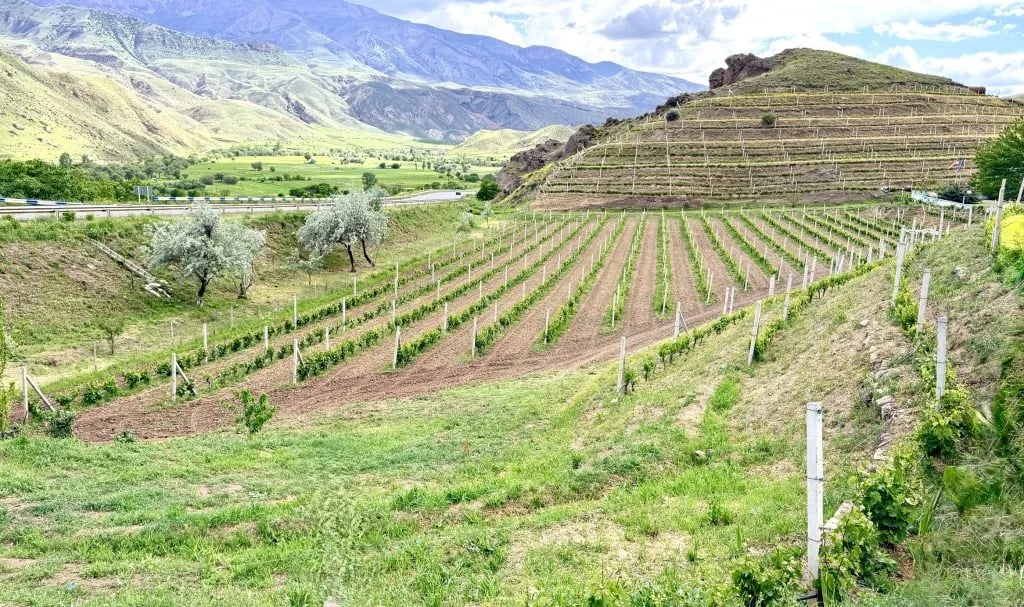
It’s mountain wine, not valley wine. Ninety percent of the country resides at over 3,000 feet. During the trip, we visited some high elevation vineyards ranging from 3,000-6,000 feet, with volcanic and rocky soils, and many with vines over 120 years old. Mt. Ararat loomed over each region we visited, providing a visual point of reference and a sense of familiar acquaintance.
Currently, vineyards cover over 30,000 acres, with roughly 300 native varieties identified, and more than 150 producers. There are five different geographic regions – Vayots Dzor, Aragatsotn, Ararat Valley, Armavir, Tavush, and Artsakh – all with different elevations, climates, soil types.
The climate is extreme – perfect for exacting suffering on winegrapes – hot summers, freezing winters, and over 300 days of sun and very little rain. Soil types vary significantly throughout the country, from volcanic and alluvial mountain soils in Aragatsotn, to rocky, volcanic, limestone soils in Vayots Dzor.
From a winemaking perspective, being landlocked has its benefits. While most western European countries suffered vine death due to phylloxera, Armenia escaped unscathed. There was no need to graft vines and 90% of the vineyards are on their own rootstock, which are ideal for the propagation of indigenous varieties.
In addition to the Areni-1 Cave, grape seed residue was found at the Karmir Blur archaeological site, only 10-15 minutes outside of Yerevan. Over 500 “Karas” (amphorae) were uncovered there.
And finally, if you are still not convinced, Armenia is so approachable, and not yet over touristed like so many wine regions. They received only 50,000 wine tourists in 2025. This is a discovery opportunity.
Until you go, ask about Armenian wines in your local wine shops and restaurants, as there is a concerted push to gain distribution worldwide. It’s only a matter of time until Armenian wines are widely available.
Native grapes to know
An estimated 400+ native grapes have been discovered post-Soviet era, and Armenia’s independence in 1991. The USSR imposed strict restrictions to fine wine production and a mandate to supply brandy instead. Approximately 30-40 of these indigenous grapes are actively produced by about 150 wineries.
Here are the varieties I found and consider to be most emblematic of the wines of Armenia. And they taste like they’re coming from somewhere else. Don’t worry about pronunciation, just taste and enjoy.
Areni Noir is the flagship red. It’s light bodied, some say like pinot noir, red fruited, spicy with vibrant acidity. Interestingly, “Areni” is a city, archeological site, AVA, and a grape varietal.
Voskehat is the leading white and orange wines variety. Its floral, ripe-fruited, textured and elegant. Maybe reminiscent of Rhone whites like marsanne, roussanne, and viognier.
Other native grapes you may find include Khndoghni, Lalvari, Garan Dmak, Kakhet, Kangun and Haghtanak, Tozot, Karmrahyut, Khatun, and Kharji. Here’s some additional information and descriptions for both red and white native varieties.
Footnote: International grapes most common are syrah, malbec, sauvignon blanc, and cabernet sauvignon.
Wineries to visit
In 1991 there were only a handful of wineries and limited opportunity for wine interested visitors. Now, you’ll find 30-50 wineries, primarily located in the Vayots Dzor (90 minutes south), and Aragatsotn regions (45 minutes north) of the capital city Yerevan. Most of the wineries noted have tasting rooms open to the public. Here are the wineries I’m familiar with that. Each is actively engaged and collaborates with organizations like TAP (The Armenia Project), and the Vine & Wine Foundation.
Northern Terroir – I suggest starting here as you will likely be based in Yerevan. This trendsetting, luxury brand was founded by Zara Mazmanyan, the winery was founded in 2019, and is located in the Tavush region near the border of Georgia. The focus is on white wines and bubbles only. The flagship wine TUS (named for the region) is an outstanding expression of the Lavari grape. 10,000 cases of TUS and their sparkling wine ZOE are produced and significant growth is expected. This winery and its characters are worth watching.
You can visit the winery, but based on my post CMB conference experience, I suggest you stay in the Grand Yerevan Hotel in central Yerevan. Located next corner is Northern Terroir’s wine and cocktails bar “Piccolo”, open daily from 5pm – 2am. You will be well tasted and entertained. Reservations suggested.
Read Zara’s Wine Characters Interview
Keush – founded by expatriate Vahe Keushguerian in the Vayots Dzor region. Vahe founded WineWorks, and winery incubator that supports several producers. His vineyards are the highest elevation in Armenia at over 4,000 feet. This is ideal for the production of Traditional Method sparkling wine (Keush was the first produced in Armenia), and still wines from Voskehat, Khatouni, and Areni-Noir.
Vahe and daughter Aimee (she has her own brand, Zulal), have been much lauded in the news, and specifically on Somm: Cup of Salvation (Apple TV and Amazon) for their cross-border sourcing of Iranian grapes. There is no tasting room, but you’ll find their wines distributed throughout Armenia, Canada, U.S., France, Russia, Sweden, U.K., Switzerland, Belgium and Estonia, Lithuania, and Latvia.
Read Vahe’s Wine Characters Interview
A tour of Van Ardi Winery (Courtesy of Carl Giavanti).
Van Ardi – Founded by Expat Varuzhan Mouradian, located in Aragatsotn, founded the winery in 2008. It’s biodynamically farmed at 3,000 feet on volcanic soils with a focus on native varieties, and also Syrah and Zinfandel. Tours and tastings range between U.S. $10-$40 and four different packages are offered, including an option for lunch. I enjoyed lunch here and can recommend without hesitation. Each includes a fine cup of Armenia wine to wrap up your visit.
Read Varuzhan’s Wine Characters int erview
Old Bridge Winery – Founded in 1998 by the Khalatyans family, who will likely be on hand to greet you during your visit. The Arpa Valley winery in Vayots Dzor is named for the old silk road bridge which served travelers in the 13th century.
Areni-Noir and Voskehat are the focus, but they also produce grape-based vodkas, grappa, and olive oil, which are available during your visit. Lunch and winetasting packages, as well as B&B lodging reservations are available on their website.
Trinity Canyon Vineyards – founded in 2008 in the Vayots Dzor Valley by Hovakim Saghatelyan, an American expat and two friends, with a focus on organic wine production. The winery is Armenia’s first to be certified organic. Both native and international grapes are available for tastings.
Open daily except Mondays from 11am – 7pm (last reservation 5pm), walk-in visits are available, with tastings, glasses and bottles available. Packages include cellar tours and lunch by appointment.
Read Hovakim’s Wine Characters interview
Alexandrea Winery – Adam Kablanian returned from Silicon Valley to found the winery in 2017. He is an active philanthropist and winegrower. This winery is not open to the public but the wines – both native and international grapes – can widely be found both in Armenia and other countries including U.S. (CA, TX, VA), and Germany, as the marketing focus is distribution.
Read winegrower Adam Kablanian’s Wine Characters’ interview
Alluria – founded in 2017 by Samvel Machanyan, the winegrower and chief entertainer. The Armavir Valley winery produces about 3,000 cases from its 25 acres of indigenous estate vineyards. They practice traditional winemaking practices with a focus on native grapes. Contact the winery to arrange a tour and tasting at alluriaoffice@gmail.com
ArmAs – Aragatsotn Valley. One of the larger producers, they take a modern approach to winemaking. This is an expansive property worth touring. Guides will take you through the winery and distillery. Tastings include options for food pairing or a meal. There are several packages to consider on the website when you make your reservations. This is one of the few properties in the valley with a boutique hotel onsite.
Read winegrower Victoria Armen Aslanian’s Wine Characters interview
Karas Winery – One of the largest wineries in Armenia. Estate vineyards thrive on the volcanic soils of Armavir Valley. Their first vintage in 2007 coincided with the discovery of karas at the Areni-1 Caves. Expect to see karas when you visit. Contact the tasting room by email or WhatsApp to arrange and appointment.
Read winemaker Juliana Del Aguila’s Wine Characters interview
The story continues
What exists now is not really a reinvention—it’s more like picking things back up after years of neglect. Vineyards are being replanted, native grapes are coming back, and a lot of smaller producers are just figuring out where to take things next. Armenia was never off the wine map. People are just starting to notice again. Now is your time to discover it.
– Carl Giavanti is a senior contributor with VineRoutes, focusing on destination-driven storytelling, winemaker profiles, and educational features that bridge travel, context, and character.
network@winearmenia.org
© WineArmenia 2026