
A Taste of Armenian Wines in Germany
The Armenian Mirror-Spectator
7/16/20263 min read
Originally published by The Armenian Mirror-Spectator at https://mirrorspectator.com/2026/07/16/a-taste-of-armenian-wines-in-germany/
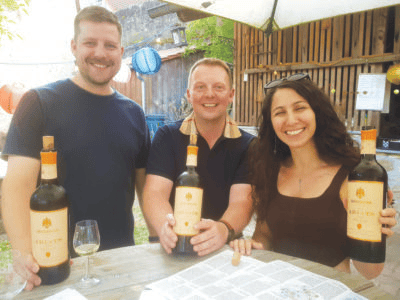
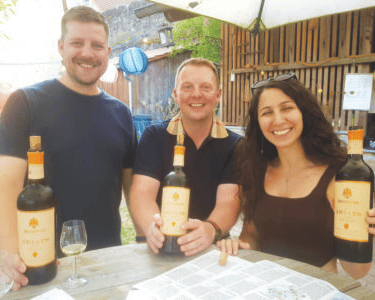
HESSE, Germany — While the American communities in most German cities invited their German friends to join them in barbecues featuring hot dogs, hamburgers, potato chips, and beer (or a soft drink for the children) on July 4, members of the Armenian community in Hesse hosted a Weinprobe, a traditional German wine tasting event, with Armenian wine.
Given that Germany is more famous for its wine than its beer, and that Hessen is home of the most prestigious and bountiful vineyards in the Rhine valley, (Rheingau) this was a significant, if not bold initiative….
Hosting the event was NOAH e.V., a non-profit association dedicated to promoting cultural relations between Armenia and Germany. The venue for the wine-tasting was the historic Königshalle Kloster Lorsch (King’s Hall, Lorsch Monastery), located in Lorsch, a wine-growing city on the Rhine. Arrangements for use of the adjacent Klosterschänke — literally “monastery tavern” — were made by the family of Ernst-Ludwig Drayss, co-founder and treasurer of NOAH.
This magnificent Carolingian monastery, a UNESCO world cultural heritage site, dates back to the times of Charlemagne, when wines were first produced there; today it is known for its Riesling and Pinot Noir wines. Germany, and the Rheingau in particular, is proud of its 13-century-long tradition of excellence in wine production.
Although the Armenian wines tasted on Independence Day were produced in recent years, the oldest from 2020, Armenian wine-making dates back 6000 years. The vintners explain the quality of the “new” wine in the continuation of an age-old tradition, based on a unique terrain, still present today. This is characterized by the combination of high altitudes, volcanic soil, and microclimate. More than 30 guests gathered for the wine-tasting, Germans and Armenians.
Michael Strauss, chairman of NOAH, selected the six wines to be tasted, and moderated the proceedings under the motto: “Discovering the vast array of Armenian wines.”
The wines he offered started with Stork Kangoun 2023, a dry white wine from Ararat/Ara Region, and two dry white wines from Vayots, Dzor Region, Ariats Voskehat 2024 and ARIATS Voskehat Orange Reserve 2023. The first red wine was an Arctur, Karmrahyut, from Byurakan, Aragatsotn, whose name “describes the uniqueness of the wine – like Arcturus, the brightest star in the northern hemisphere.” The second red wine was Hazarvaz, Areni Noir 2022, the grapes harvested from a century-old vineyard in Yerevan/Vayots Dzor region, with only 1000 vines. The last wine, a Vozkevaz Karasi Collection, Haghtanak 2020, from Ararat/Aragatsotn Region, is an amphora wine, made from a native Haghtanak grape found only in Armenia.
Vintners in Germany organize wine-tasting events to present the produce of their recent harvests and acquire new customers. The hosts in Lorsch stressed the fact that a wine-tasting is far more than merely sampling; it is an intercultural encounter, an exchange which brings together the customs, history, and climate conditions of different regions. Noteworthy was the presence among the guests of Franconian-Armenian vintner Garnik Harunyan.
When it comes to tasting Armenian wines in the heart of Germany Rhine Valley, one might imagine that after the first two or three glasses, intercultural exchange might lead to engaging participants in profound inquiries regarding, for example, the relative excellence of Germany’s and Armenia’s viniculture. As for the relative antiquity of viniculture in the two peoples’ history, that is not a matter of debate. But, as host Strauss (with a wink of the eye) explained, Georgians and Armenians do argue about who was first to cultivate grapes for the purpose of producing wine. The answer, he said, was to be found in the Bible. In the Book of Genesis, it is related that after the flood, Noah’s ark landed on Mount Ararat. When the waters had receded, God told Noah to leave the ark with all his family and the livestock, and he did so. “And Noah began to be an husbandman, and he planted a vineyard; And he drank of the wine, and was drunken….” (Genesis, 9, 20-21).
network@winearmenia.org
© WineArmenia 2026